




Next.js vs React.js: Which Framework Should Your Business Choose?
Choosing the right technology for a business website can have a major impact on performance, scalability, SEO, development costs, and the overall user experience. Two names that frequently appear in this conversation are React.js and Next.js.
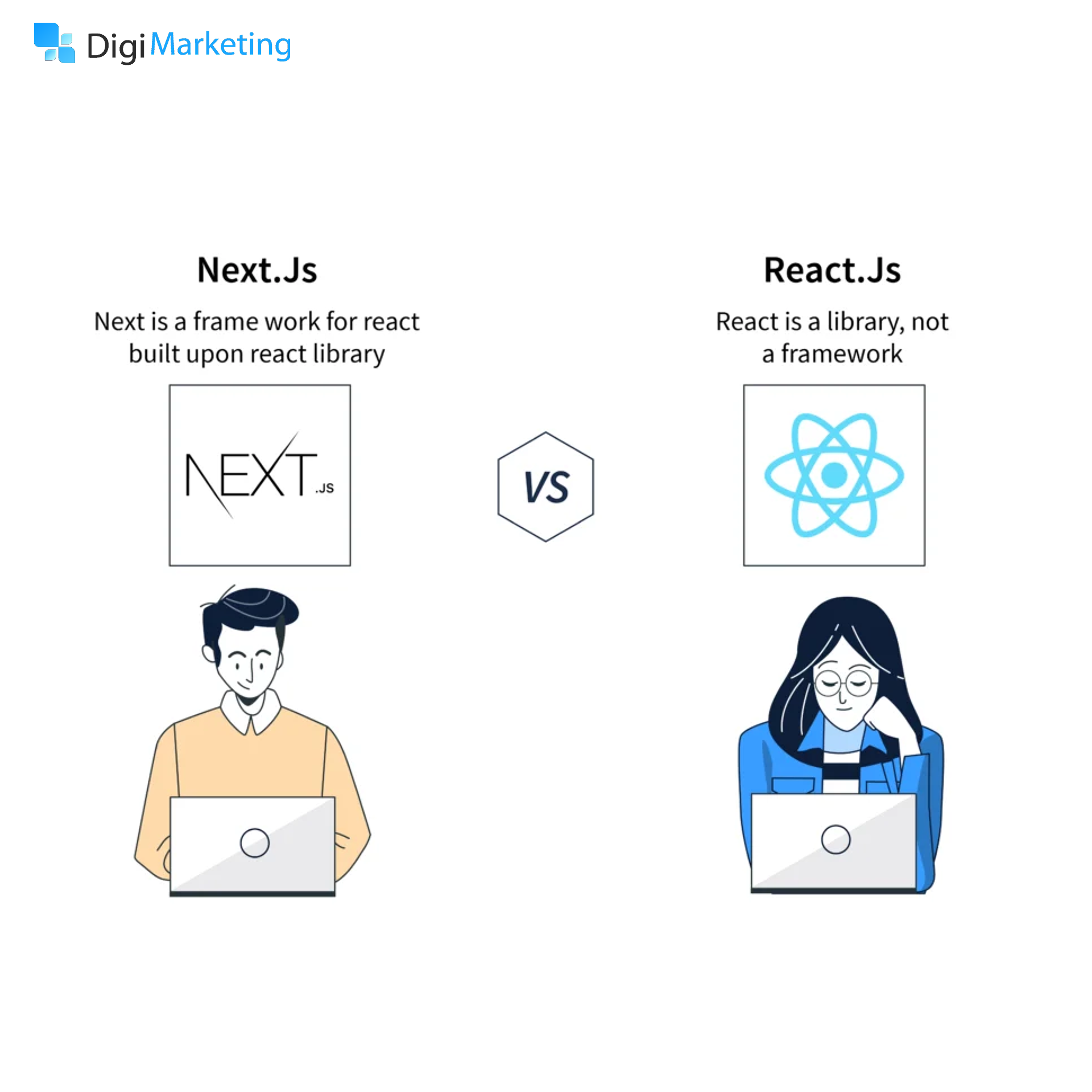
Although they are closely related, React.js and Next.js are not the same thing. React is a JavaScript library for building user interfaces, while Next.js is a React framework that adds features and structure for building complete web applications.
So, which one should your business choose?
For many modern business websites, Next.js is the more complete option, particularly when performance, SEO, scalability, and server-side functionality are priorities. However, React.js can still be an excellent choice for certain applications.
Let’s compare them in detail.
What Is React.js?
React.js is an open-source JavaScript library designed for creating interactive user interfaces using reusable components.
Instead of building every page as a completely separate piece of code, developers can create reusable components such as:
- Navigation bars
- Buttons
- Forms
- Product cards
- Testimonials
- Pricing sections
- Interactive dashboards
These components can then be combined to create complete interfaces.
This flexibility is one of React’s biggest advantages, but it also means developers often need additional tools when building a complete application.
What Is Next.js?
Next.js is a React framework designed for building full-stack web applications.
It uses React for creating the user interface while adding features and infrastructure for things such as routing, rendering, data fetching, caching, and performance optimization.
The current Next.js App Router also supports React Server Components and provides features such as layouts, nested routing, loading states, error handling, and server-side functionality.
In simple terms:
React.js vs Next.js: Key Differences
Feature | React.js | Next.js |
Type | JavaScript library | React framework |
UI Components | Yes | Yes |
Routing | Requires additional solution | Built-in |
Server-Side Rendering | Requires additional setup | Supported |
Static Generation | Requires additional tools/setup | Supported |
Full-Stack Development | Requires additional technologies | Supported |
SEO Flexibility | Depends on implementation | Strong framework-level support |
Performance Tools | More developer-managed | Many built-in capabilities |
Application Structure | Flexible | More structured |
Best For | Interactive applications and custom frontends | Business websites and full-stack applications |
1. SEO: Which Is Better?
For businesses that depend on organic search traffic, SEO should be one of the most important considerations.
React can absolutely be used to build SEO-friendly websites. However, a React application built from scratch may require additional configuration and tools to implement different rendering strategies and application requirements.
Next.js provides multiple rendering approaches and framework-level features that make it easier to build websites where important content can be rendered on the server or generated ahead of time. React itself now recommends starting new applications with a framework when appropriate.
Why Next.js Can Be Better for SEO
Next.js can support:
- Server-side rendering
- Static site generation
- Dynamic routing
- Metadata management
- Structured data implementation
- Optimized page delivery
- Flexible rendering strategies
This is particularly useful for websites with important landing pages, service pages, product pages, and blog content.
2. Website Performance
Website performance affects user experience and can influence how effectively visitors interact with your website.
React applications can be extremely fast, but performance depends heavily on how the application is built and optimized.
Next.js provides additional features designed to help developers build performant applications, including different rendering strategies, caching capabilities, code splitting, and server-side rendering.
With the Next.js App Router, components are server components by default, allowing developers to reduce the amount of JavaScript that needs to be sent to the browser for certain parts of an application.
However, it is important to remember that Next.js does not automatically make every website fast. Poor coding, oversized images, excessive third-party scripts, and inefficient APIs can still create performance problems.
Performance winner: Next.js
3. Development Flexibility
React is intentionally flexible.
Developers can choose their preferred routing solution, data-fetching approach, state management system, and build tools. This makes React attractive for teams that want complete control over their technology stack.
The downside is that developers have to make more architectural decisions.
Next.js provides more structure out of the box.
For example, Next.js includes file-system-based routing and framework conventions that reduce the amount of configuration developers need to create themselves.
4. Scalability
A business website might start with only a few pages but eventually grow into a much larger platform.
Imagine a company that starts with:
A few years later, it may have:
- 50+ service pages
- Hundreds of blog articles
- Case studies
- Location pages
- Product pages
- Customer dashboards
- Integrations
- Personalized content
Next.js is designed to support applications ranging from content-heavy websites to complex full-stack applications. Its built-in routing, rendering, caching, and server capabilities can provide a structured foundation as a project grows.
React can also scale successfully, but teams may need to select and maintain more supporting technologies.
Scalability winner: Next.js
5. Development Complexity
One advantage of React is that developers can start relatively small.
You can build reusable components and gradually add functionality based on the project’s requirements.
Next.js introduces more concepts, including:
- Server Components
- Client Components
- Server-side rendering
- Static rendering
- Dynamic rendering
- Routing conventions
- Caching
- Server Actions
This can create a steeper learning curve for developers who are new to modern React development.
For an experienced development team, however, these features can reduce the need to build common application infrastructure from scratch.
Simplicity winner: React.js
6. Business Website Development
If your company needs a standard business website with pages such as:
Home → About → Services → Blog → Contact
Next.js is often an excellent choice.
Why?
Because business websites commonly require:
- Strong SEO
- Fast loading
- Mobile responsiveness
- Flexible page structures
- Content management
- Good Core Web Vitals
- Analytics integration
- Structured data
- Scalable architecture
Next.js provides a strong foundation for these requirements.
React can also accomplish them, but developers may need to assemble more of the underlying architecture themselves.
Business website winner: Next.js
7. E-Commerce Websites
Both technologies can be used for e-commerce.
React is useful when building highly interactive shopping experiences, while Next.js can provide the broader application infrastructure needed for product pages, dynamic routes, server-side functionality, and performance optimization.
For example, an online store could have thousands of URLs such as:
/products/shoes
/products/mens-running-shoes
/products/mens-running-shoes/product-name
8. Web Applications and Dashboards
This is where the comparison becomes more balanced.
If your business needs an internal dashboard, CRM interface, analytics platform, or highly interactive application, React can be an excellent choice.
For example:
- Admin dashboards
- Project management tools
- Internal business software
- Data visualization platforms
- Interactive applications
These experiences often rely heavily on client-side interactions.
However, Next.js can also handle these applications and provides server-side capabilities when they are useful.
Winner: Depends on the project
9. Hosting and Deployment
Next.js supports deployment through different approaches. According to the React documentation, Next.js applications can be deployed with hosting providers supporting Node.js or Docker, and Next.js also supports static export for deployments that don’t require a server.
This gives businesses flexibility depending on their hosting requirements.
React applications can also be deployed to static hosting platforms, CDNs, or other infrastructure depending on how the application is built.
The right choice ultimately depends on the application’s architecture and hosting requirements.
When Should Your Business Choose React.js?
React.js may be the better choice if your business:
- Needs a highly interactive frontend
- Already has an established React development team
- Wants maximum control over the application architecture
- Is building an internal dashboard
- Has existing infrastructure built around React
- Does not require extensive framework-level features
- Wants to integrate React components into an existing website
React’s flexibility can be particularly valuable for custom applications.
When Should Your Business Choose Next.js?
Next.js is usually the stronger choice if your business needs:
- An SEO-focused website
- A high-performance business website
- A scalable e-commerce platform
- A content-heavy website
- Server-side functionality
- Static and dynamic rendering
- Built-in routing
- Modern full-stack React development
- A structured development architecture
For many companies building a new public-facing website in 2026, Next.js is a compelling starting point.
Next.js vs React.js for SEO: The Final Verdict
That’s not because React cannot rank in Google. React websites can perform extremely well in search when they are properly implemented.
The difference is that Next.js provides a framework with rendering, routing, metadata, caching, and other capabilities that can make it easier to build a technically strong website.
React gives you the building blocks.
Next.js gives you the building blocks plus a structured framework for turning them into a complete application.
Conclusion
The choice between React.js and Next.js should depend on your business goals rather than simply choosing the technology that is more popular.
Choose React.js when flexibility and a highly customized frontend architecture are your primary priorities.
Choose Next.js when you want a more complete framework for building a fast, scalable, SEO-friendly, and full-stack web application.
For most businesses launching a new SEO-focused website today, Next.js is likely to be the more practical choice. It combines the power of React with additional framework features that can reduce development overhead and provide a stronger foundation for modern business websites.
Ultimately, the technology is only one part of the equation. Your website’s SEO strategy, content quality, technical implementation, user experience, and ongoing optimization will all play important roles in its success.
Final Thoughts
A successful business website needs more than an attractive design. It needs a strong technical foundation that supports search engine crawling, fast page delivery, mobile usability, and a positive user experience.
Next.js provides many of the tools developers need to build that foundation. When combined with high-quality content, keyword research, internal linking, structured data, technical SEO, and ongoing performance monitoring, it can become an excellent platform for building an SEO-friendly business website.
In short, Next.js doesn’t guarantee higher Google rankings—but it gives businesses the flexibility and performance capabilities needed to build a website that is technically prepared for modern SEO.
 Schedule a Call Today