




10 Google Ads Mistakes Singapore Businesses Should Avoid
Google Ads is one of the fastest ways for businesses in Singapore to generate qualified leads, increase website traffic, and grow sales. However, simply launching a campaign doesn’t guarantee success.
Many businesses invest thousands of dollars in Google Ads but fail to see meaningful results because of avoidable mistakes. Poor targeting, weak landing pages, and ineffective campaign management can quickly drain your advertising budget without delivering a positive return on investment (ROI).
In this guide, we’ll explore the 10 most common Google Ads mistakes Singapore businesses should avoid and provide practical tips to help you run more effective campaigns.
1. Choosing the Wrong Keywords
Your keywords determine who sees your ads. If you target broad or irrelevant search terms, you’ll attract visitors who are unlikely to convert.
Common Mistakes
- Using overly broad keywords
- Ignoring search intent
- Targeting low-relevance phrases
- Choosing keywords based only on search volume
For example, a law firm targeting “law” may attract users looking for legal definitions instead of legal services.
Best Practice
Focus on high-intent keywords such as:
- Family lawyer Singapore
- Corporate lawyer Singapore
- Divorce lawyer consultation
These searches indicate that users are actively looking for professional services.

2. Ignoring Negative Keywords
Negative keywords prevent your ads from appearing for irrelevant searches.
Without them, you may pay for clicks from users who are unlikely to become customers.
Examples
If you offer premium accounting services, you may want to exclude searches such as:
- Free accounting software
- Accounting jobs
- Accounting course
- Internship
Review your Search Terms Report regularly and add new negative keywords to reduce wasted spend.
3. Sending Traffic to Your Homepage
One of the biggest mistakes is directing ad traffic to a generic homepage.
Visitors should land on a page specifically designed for the product or service advertised.
Better Approach
Instead of:
Homepage
Use:
- Google Ads Services page
- SEO Services page
- Free Consultation landing page
- Product-specific landing page
Relevant landing pages improve user experience and conversion rates.
4. Writing Weak Ad Copy
Even if your keywords are perfect, poor ad copy can reduce click-through rates (CTR).
Avoid generic messaging like:
We Offer Great Services
Instead, highlight clear benefits.
Examples:
- Free Consultation Available
- Trusted by 500+ Singapore Businesses
- Certified Google Ads Specialists
- Same-Day Service
Strong headlines and compelling descriptions encourage more qualified clicks.
5. Not Tracking Conversions
Many businesses measure success using clicks alone.
However, clicks don’t tell you whether users:
- Submitted a contact form
- Made a purchase
- Called your business
- Booked an appointment
Set up proper conversion tracking using:
- Google Ads Conversion Tracking
- Google Analytics 4 (GA4)
- Google Tag Manager (GTM)
This data allows you to optimize campaigns based on actual business outcomes.
6. Using a "Set and Forget" Approach
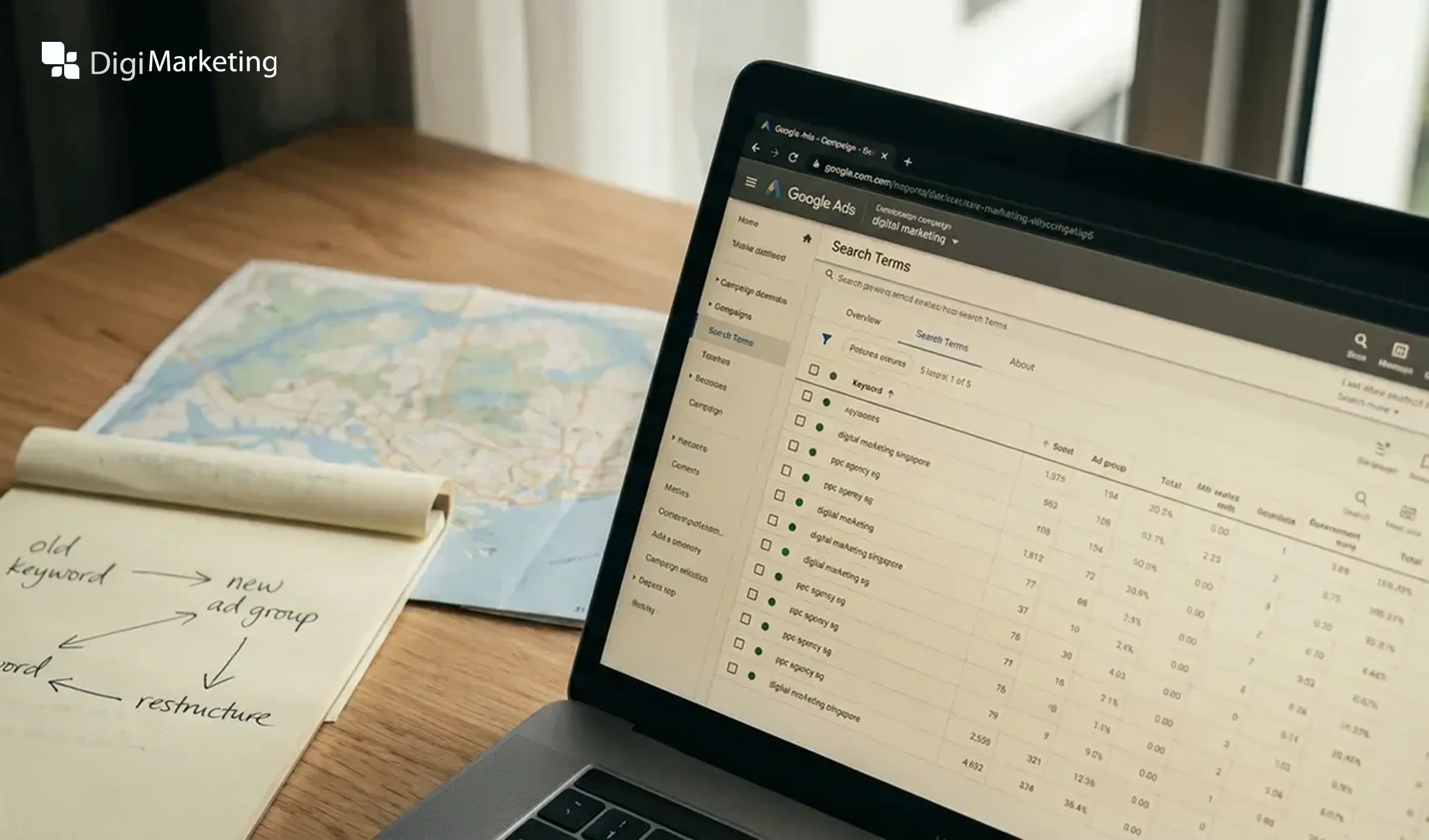
Google Ads requires continuous optimization
Many businesses launch campaigns and never review them again.
Regular optimization includes:
- Adjusting bids
- Reviewing search terms
- Updating ad copy
- Testing new keywords
- Monitoring Quality Score
- Improving landing pages
Weekly or bi-weekly reviews can significantly improve campaign performance
7. Ignoring Mobile Users
A significant share of Google searches in Singapore comes from mobile devices.
If your landing page isn’t mobile-friendly, potential customers may leave before converting.
Check that your page:
- Loads quickly
- Displays correctly on all screen sizes
- Uses readable text
- Has clickable buttons
- Features easy-to-complete forms
A smooth mobile experience can improve both user satisfaction and conversion rates.
8. Focusing Only on Clicks Instead of ROI
High click-through rates don’t always translate into business success.
Instead of asking:
How many clicks did we receive?
Ask:
- How many qualified leads did we generate?
- What was our Cost Per Acquisition (CPA)?
- What was our Return on Ad Spend (ROAS)?
- Did revenue increase?
Tracking meaningful business metrics helps you make smarter advertising decisions.
9. Not Testing Different Ad Variations
Running a single version of an ad limits your ability to improve performance.
Test different:
- Headlines
- Descriptions
- Calls-to-action
- Display paths
- Offers
A/B testing helps identify which messaging resonates most with your audience.
Even small improvements in CTR or conversion rate can have a significant impact over time.
10. Trying to Compete on Every Keyword
Many businesses try to rank for every keyword in their industry.
This often results in:
- Higher advertising costs
- Lower relevance
- Reduced ROI
- Delivery updates
- Customer feedback
- Promotional offers
Instead, prioritize keywords that align with your services and business goals.
For example, a digital marketing agency might focus on:
- Google Ads Management Singapore
- PPC Agency Singapore
- Google Ads Consultant Singapore
rather than broad terms like:
- Marketing
- Advertising
- Business
Targeted campaigns usually deliver better-quality leads at a lower cost.
Bonus Tip: Don't Ignore Quality Score
Google’s Quality Score measures the relevance of your:
- Keywords
- Ads
- Landing pages
A higher Quality Score can lead to:
- Lower Cost Per Click (CPC)
- Better Ad Rank
- Improved visibility
- More efficient use of your budget
Improving Quality Score is one of the most effective ways to increase campaign performance over time.
Quick Google Ads Audit Checklist
Before launching or reviewing your campaigns, ask yourself:
- Are my keywords relevant to customer intent?
- Have I added negative keywords?
- Does each ad point to a dedicated landing page?
- Is my ad copy benefit-focused?
- Have I set up conversion tracking?
- Am I reviewing campaigns regularly?
- Is my landing page mobile-friendly?
- Am I measuring ROI instead of just clicks?
- Have I tested multiple ad variations?
- Am I targeting the right audience?
If you answered “No” to any of these, there may be opportunities to improve your campaign performance.
Frequently Asked Questions
Why do some Google Ads campaigns fail?
Campaigns often underperform due to poor keyword selection, weak landing pages, lack of conversion tracking, low-quality ad copy, or insufficient optimization.
How often should I optimize my Google Ads campaigns?
Most businesses should review campaign performance at least once a week. High-budget or competitive campaigns may require daily monitoring.
What is the biggest Google Ads mistake?
One of the most costly mistakes is failing to track conversions. Without accurate data, it’s difficult to know which keywords, ads, or campaigns are generating real business results.
Can a small business manage Google Ads successfully?
Yes, but success requires ongoing monitoring, optimization, and a clear understanding of your audience. Many SMEs choose to work with experienced Google Ads professionals to maximize their return on investment.
Final Thoughts
Google Ads can be a powerful growth channel for Singapore businesses, but success depends on more than simply creating ads. Avoiding common mistakessuch as targeting the wrong keywords, neglecting negative keywords, sending traffic to generic pages, or failing to track conversionscan dramatically improve your campaign performance.
The most effective advertisers continually test, refine, and optimize their campaigns based on real data. By following these best practices, you can reduce wasted ad spend, attract higher-quality leads, and achieve stronger long-term results from your Google Ads investment.
 Schedule a Call Today